He Is Everywhere in Tibet
Walk into any Tibetan home. Look at the family altar. He is there.
Walk into any monastery. Any roadside shrine. Any cave hermitage between Lhasa and Kathmandu.
He is there too.
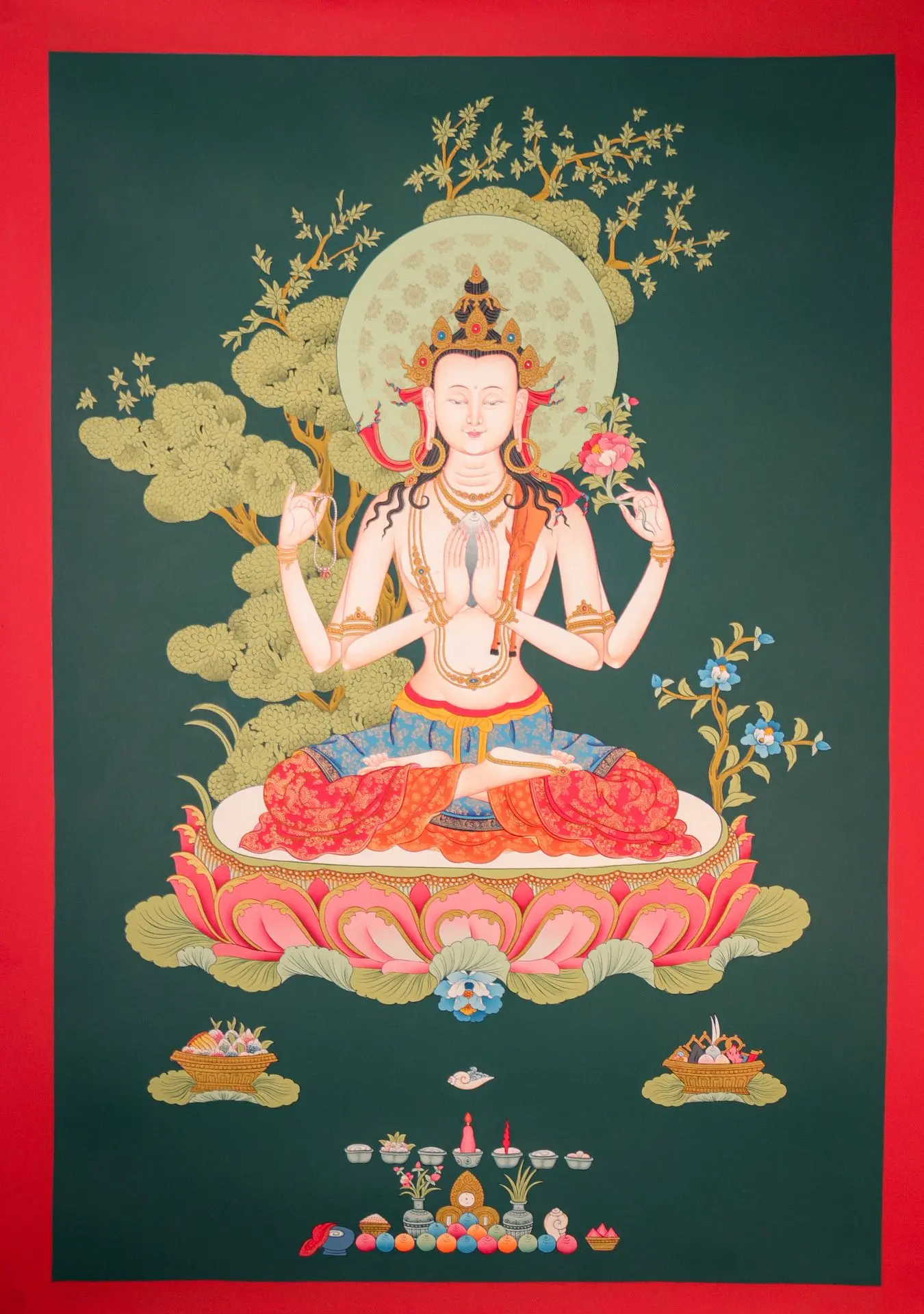
His white form glows softly. His four arms reach outward. His eyes look downward, not in sadness, but in attention.
He is watching you. He is watching everyone.
His name is Chenrezig. Tibet calls him the heart of its civilization. The West knows him as Avalokiteshvara.
His mantra, "Om Mani Padme Hum," is perhaps the most recited prayer on earth. Six syllables. Billions of daily repetitions.
Carved into mountainsides. Spinning on water-powered wheels. Whispered by dying grandmothers. Chanted by three-year-old monks at dawn.
No deity in Tibetan Buddhism is more loved. No spiritual figure has shaped a culture more completely.
This is his story.
How It All Began: The Birth of Infinite Compassion
A Vow That Shook the Universe
The story begins before time had a name.
A young prince stood before his teacher. His teacher was Amitabha — the Buddha of Infinite Light.
The prince looked out at the universe. He saw suffering everywhere. Not just human suffering.
Animal suffering. Ghost suffering. The suffering of beings in hell realms. The suffering of gods who would eventually fall.
Suffering without edge. Suffering without end.
The prince made a vow. It was insane. It was beautiful.
"I will not rest until every single being is free from suffering. Every last one. If I ever abandon this task, may my body shatter into a thousand pieces."
Not just humans. Not just good people. Every ant. Every fish. Every confused, struggling, terrified creature in all of existence.
Amitabha smiled. He knew the cost of such a vow. He blessed the prince anyway.
The prince became Avalokiteshvara. The One Who Hears Every Cry.
The Moment His Head Exploded
Find this thangka here.
Centuries passed. Avalokiteshvara worked tirelessly.
He reached into hell realms and pulled beings out. He taught the confused and comforted the grieving. He guided the lost back toward the light.
Millions found freedom through his efforts. Billions, perhaps.
Then he paused. He looked out at the universe again.
Suffering had not decreased by even one fraction.
For every being he liberated, countless more arose. The ocean of pain was exactly as vast as before. His work had changed nothing.
Despair crushed him. For one terrible moment he thought: "It is impossible. I cannot do this."
And his vow activated.
His head split into ten pieces. His body shattered like porcelain dropped from heaven.
But Amitabha was watching. Amitabha is always watching.
He gathered every fragment. He rebuilt his spiritual son — but not as before.
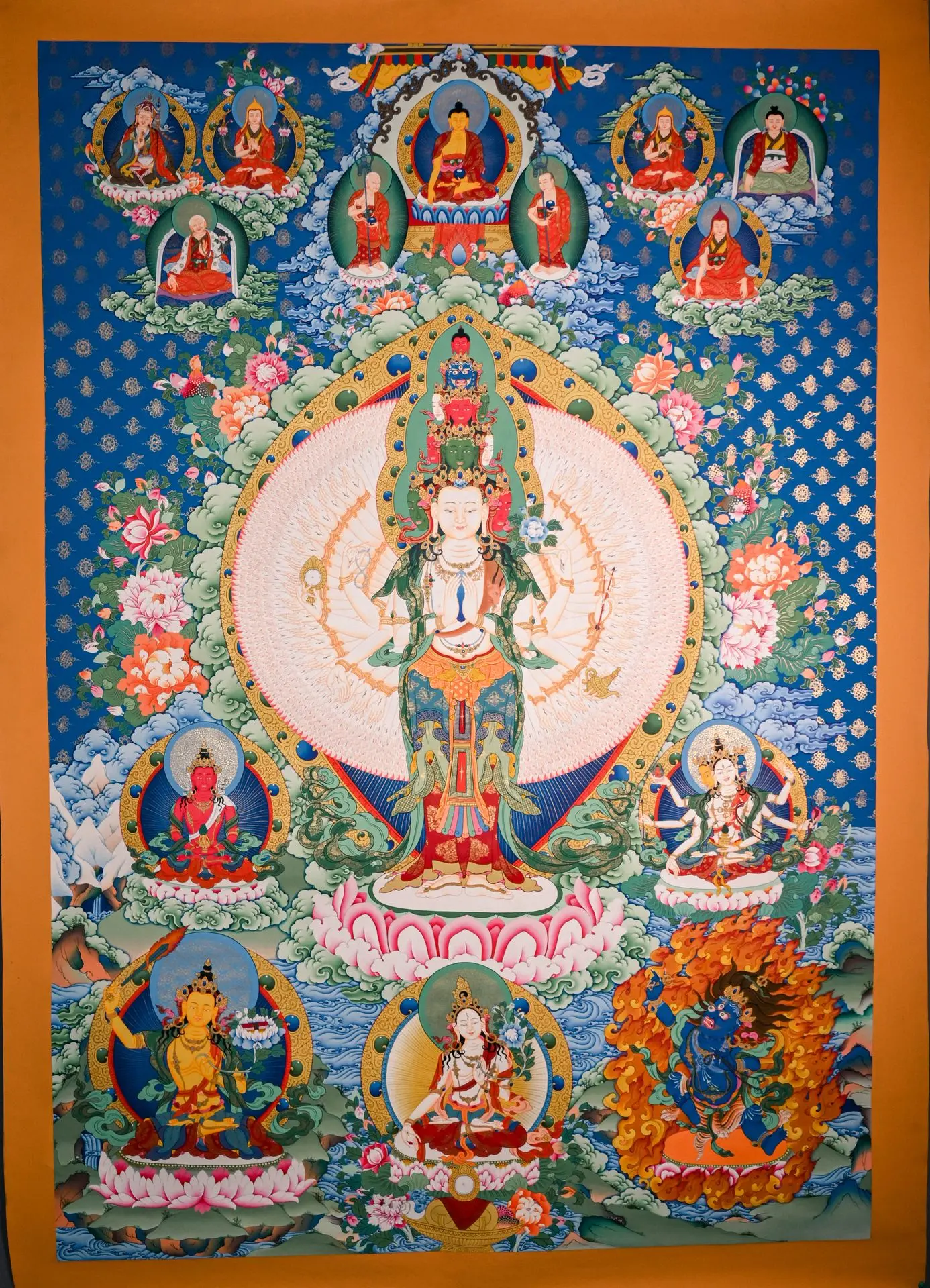
Now Avalokiteshvara had eleven heads. Stacked in tiers. Seeing in every direction simultaneously.
And one thousand arms burst from his body. Each palm containing an open eye. A thousand hands to reach every corner of existence.
The message was clear. Compassion does not give up. When it breaks, it comes back stronger.
The Name Behind the Image
What "Chenrezig" Actually Means
The Tibetan name is སྤྱན་རས་གཟིགས།
It translates as "One Who Gazes with Unwavering Eyes."
Sit with that for a moment. He is the one who never looks away.
When you suffer, he sees. When the world burns, he witnesses. His gaze does not flinch.
What "Avalokiteshvara" Means
Scholars debate the exact Sanskrit translation. Two interpretations dominate:
- "The Lord Who Looks Down with Compassion" — he gazes from above at suffering beings below
- "The Lord Who Hears the Cries of the World" — he listens to every prayer, every scream, every whispered plea
Both are true. Same being. Same boundless love. Different languages reaching toward something infinite.
His Names Across Asia
Chenrezig belongs to all of Buddhist Asia. One compassion. Many faces. Many cultures claimed by the same love.
- Tibet: Chenrezig
- India: Avalokiteshvara
- China: Guanyin — appears as female
- Japan: Kannon — also appears as female
- Korea: Gwaneum
- Vietnam: Quan Am
- Mongolia: Niduber Ujegci
His Place in the Buddhist Universe
Bodhisattva, Not Buddha — And Why That Matters
This distinction changes everything. Understanding it changes how you see him.
A Buddha has achieved complete enlightenment. The journey is finished. A Bodhisattva has reached the threshold of Buddhahood — he could step through at any moment.
But he chooses to stay.
Chenrezig remains in the burning building. Not because he cannot leave. Because he will not leave without you.
This is what makes him beloved. He is not a distant perfected being sitting somewhere comfortable.
He is the one who chose you over his own peace.
His Spiritual Family
Find this thangka here.
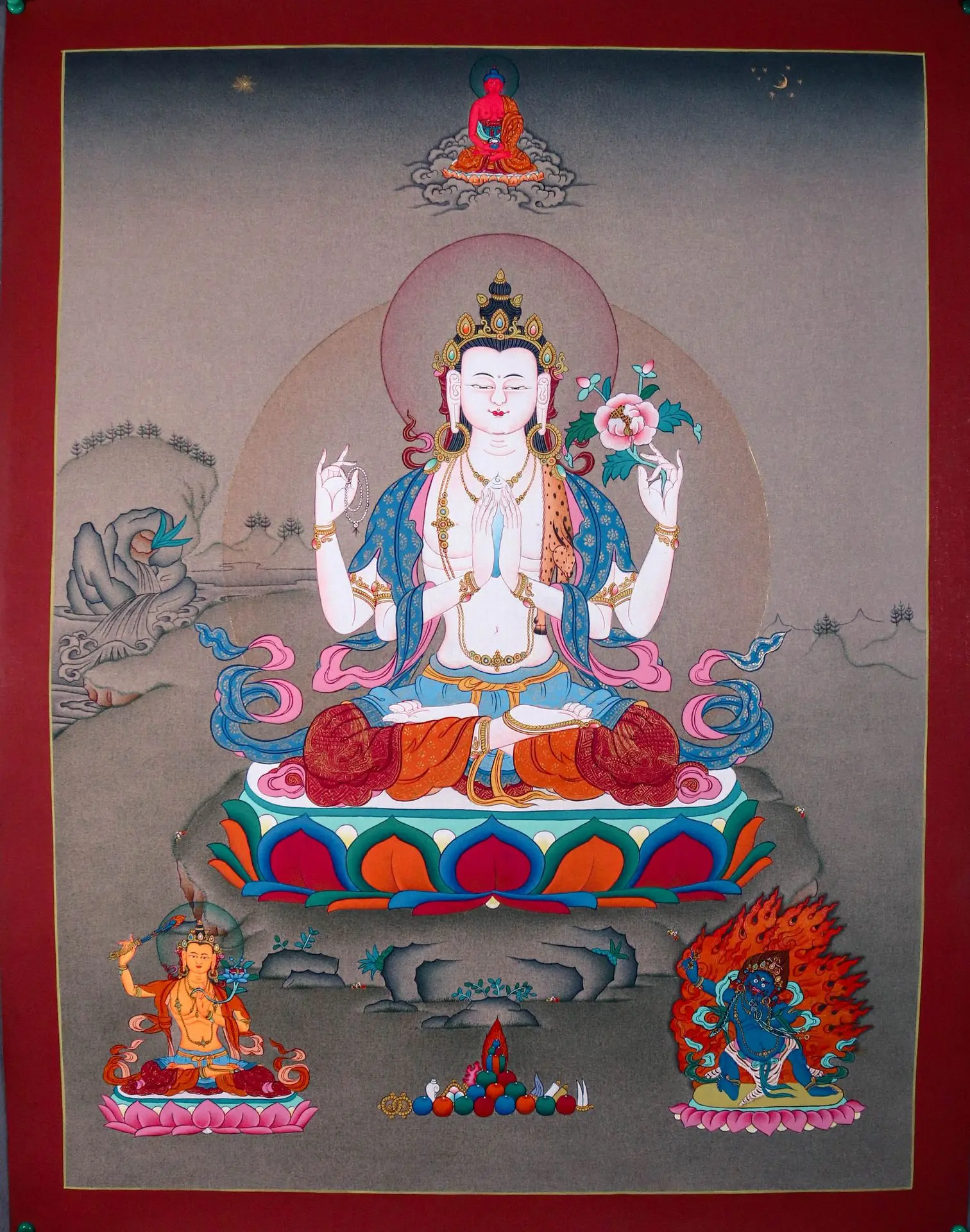
Chenrezig belongs to the Lotus Family. His spiritual father is Amitabha — the red Buddha of Infinite Light.
- The Lotus Family governs compassion, love, and emotional transformation
- Every quality Chenrezig embodies traces back to this lineage
You can always identify this connection in any image of Chenrezig. Look at his crown. You will find a small figure of Amitabha seated there. Father present in son. Source visible in emanation.
Every Form of Chenrezig: The Complete Story
Chenrezig has more forms than almost any deity in Tibetan Buddhism. The tradition counts 108 forms — perhaps more.
Each form arose to meet a specific need. Different beings. Different obstacles. Different moments in spiritual evolution.
The Peaceful Forms
Caturbhuja: The Four-Armed Chenrezig
Find this thangka here.
This is the most beloved form in all Tibet/an art.
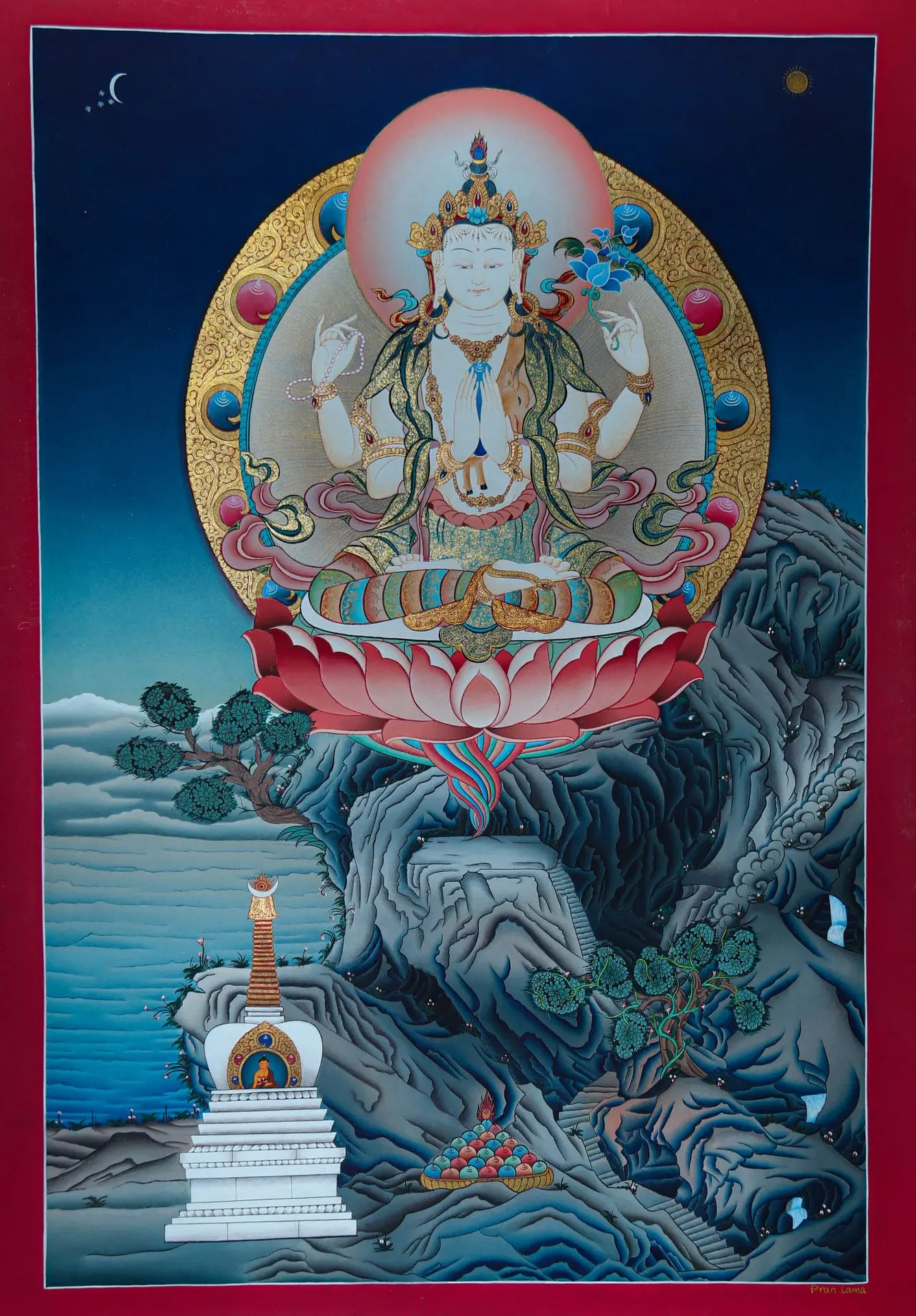
This is the Chenrezig you know. White body. Four arms. Seated on a lotus. Glowing like a hundred autumn moons.
He appears this way for ordinary beings. For people like us. He makes himself accessible. Approachable. Intimate.
Four arms — not a thousand — because four is enough to hold everything we need.
His Iconography Decoded
The White Body
Chenrezig glows white. Not flat white — radiant white.
- Purity: His compassion carries no hidden agenda
- Inclusivity: White contains all colors, just as his love embraces all beings
- Cooling presence: His energy soothes burning anger and desire
The Inner Arms: Jewel at the Heart
His two inner hands press together at his heart. Between them rests a brilliant wish-fulfilling jewel.
This gesture mirrors your own hands when you pray. When you reach toward him, he is already reaching back.
The Outer Right Arm: Crystal Prayer Beads
His outer right hand holds a mala — 108 prayer beads in an endless circle.
- The beads form an endless loop — his compassion never stops
- Each bead represents a being he is pulling toward freedom
The Outer Left Arm: The White Lotus
His outer left hand holds a white lotus in full bloom.
- Lotuses grow in muddy water — yet bloom without a speck of mud
- Enlightenment rises from confused existence — but remains completely pure
The Posture
Chenrezig sits in full lotus position. Completely stable. Completely committed.
This is not just comfortable seating. It is a statement. His commitment to you will never waver.
Royal Ornaments
He wears the ornaments of a Bodhisattva:
- A five-pointed crown representing the five Buddha wisdoms
- Jeweled necklaces representing enlightened qualities
- An antelope skin over his left shoulder — symbolizing gentleness toward all creatures
Amitabha in the Crown
Look closely at his crown. There — a small red figure. His spiritual father. Always present. Always watching.
Sahasrabhuja: The Thousand-Armed Chenrezig
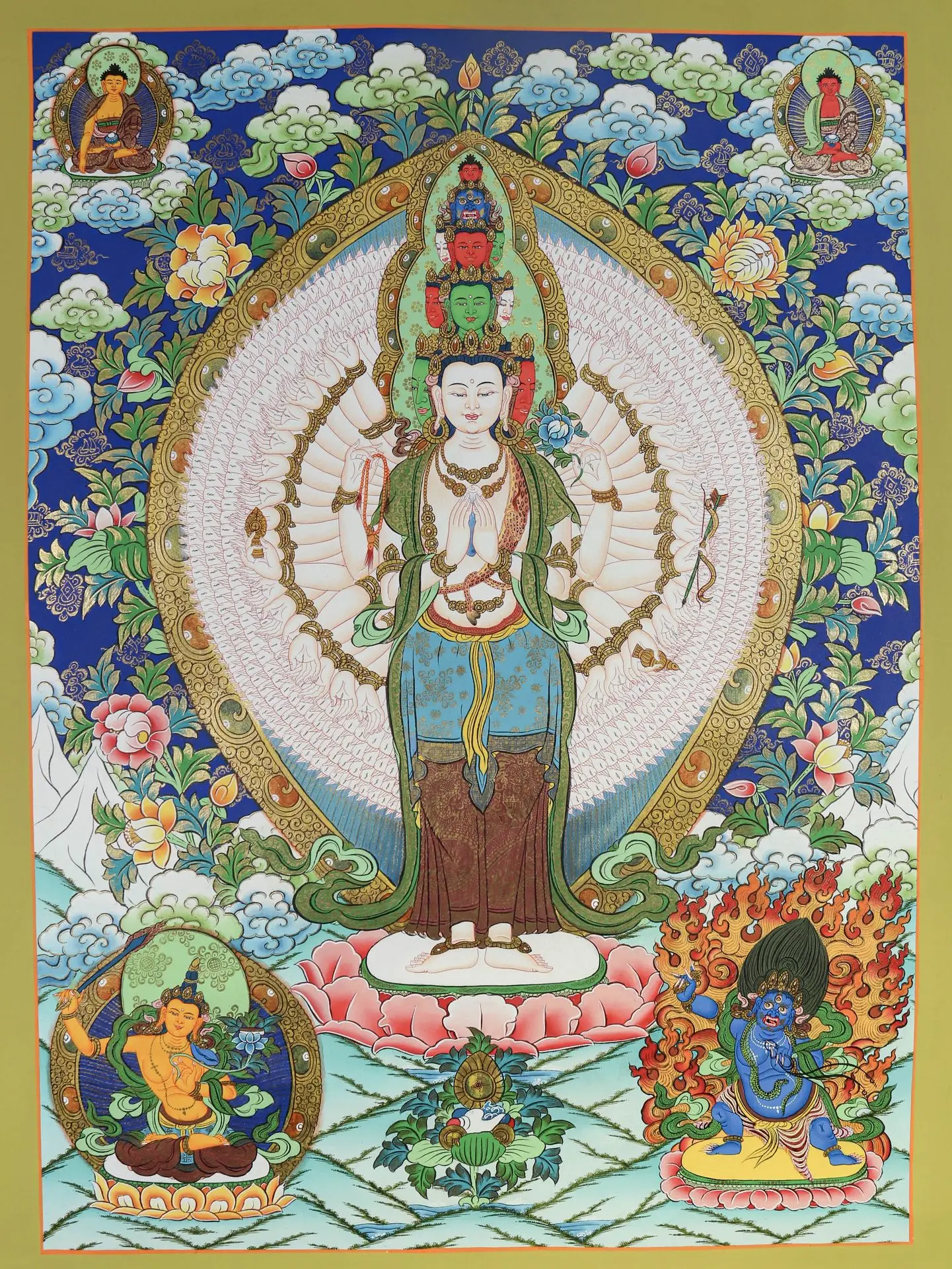
Find this thangka here.
This is the cosmic form. Compassion at universal scale.
This is the form born from his shattering. After Amitabha rebuilt him, he became this.
Eleven heads stacked in tiers. A thousand arms radiating outward like the sun's rays. Each palm containing an open eye — he sees while he reaches.
His Iconography Decoded
Eleven Heads in Tiers
Three levels of three heads — white, green, red — each facing a direction.
- A wrathful head on the fourth tier: For beings that only fierce compassion can reach
- Amitabha's face at the very top: The source, always present at the pinnacle
One Thousand Arms
Spreading in a vast circle. Each palm holds an open eye.
- He sees while he reaches — awareness inseparable from action
- Eight principal arms hold specific sacred objects for specific types of suffering
Standing Posture
Unlike the seated four-armed form, the thousand-armed Chenrezig often stands.
He is ready. He is active. He is already moving toward you.
Ekadasha: The Eleven-Headed Chenrezig
This is the form of total awareness.
Sometimes depicted without the thousand arms. Just eleven heads rising in a tower.
This form emphasizes omniscient seeing — the capacity to witness suffering in every direction and every realm simultaneously.
His Iconography Decoded
Three rows of three faces — peaceful, semi-wrathful, and wrathful. He adapts his expression to whatever each being needs.
- Wrathful face on the fourth tier — dark blue or black
- Amitabha's serene red face at the very top — the unchanging source
Padmapani: The Lotus Holder
This is the simplest and most ancient form.
This is how Indian Buddhist art first depicted Avalokiteshvara. Before Tibet. Before the thousand arms.
A single figure. Two arms. One lotus. This form appeared in the earliest Buddhist cave paintings at Ajanta. It traveled the Silk Road from India through Central Asia to Tibet.
His Iconography Decoded
- Right hand in the gesture of giving — generosity that flows naturally
- Left hand holding a lotus at his shoulder — his signature symbol
- Standing posture — relaxed, approachable, human-scaled
Shadakshari: The Six-Syllable Lord
This is the form of the mantra itself.
Shadakshari means "Lord of the Six Syllables" — referring directly to Om Mani Padme Hum.
In this form, Chenrezig IS the mantra. He embodies its six syllables. He IS the prayer that millions recite daily.
His Iconography Decoded
- Four arms similar to the standard Caturbhuja form
- The mantra prominently inscribed around him or emanating as light
- The wish-fulfilling jewel receives special visual emphasis
Khasarpana: The Sky Glider
This is the form that moves without obstruction.
Khasarpana means "sky-glider." This form of Chenrezig moves through all realms freely. No boundary stops him. No distance is too great.
His Iconography Decoded
- Seated in royal ease posture — right leg extended, left folded
- Right hand in the gesture of giving
- Often accompanied by Tara and other attendants below
The Wrathful and Semi-Wrathful Forms
Compassion is not always gentle. Sometimes love roars.
Hayagriva: The Horse-Headed Wrathful Emanation
This is the fiercest face of compassion.
When gentle methods fail — when beings are so lost in anger and confusion that soft words cannot reach them — Chenrezig does not abandon them.
He transforms.
He becomes Hayagriva. Red. Wrathful. A small green horse head bursting from his hair — neighing with a sound that shakes three realms.
This is not anger. This is compassion so intense it takes a terrifying form.
His Iconography Decoded
- Red body: Passion converted into fierce protection
- Horse head in his hair: Its neigh pierces through demonic interference
- Wrathful face with three eyes and bared fangs: Directed at whatever threatens you — never at you
His Forms
- Two-Armed Hayagriva — the most basic wrathful form
- Four-Armed Hayagriva — increased protective power
- Six-Armed Hayagriva — advanced practice form
- Eight-Armed Hayagriva — the most elaborate standard form
- Yab-Yum Hayagriva — in union with Vajravarahi, wisdom and compassion inseparable
- Padma Hayagriva — emphasizing his Lotus Family connection
- Tamdrin — the Tibetan name used in Nyingma practice
- Three Fierce Ones — combined with Vajrapani and Garuda in one image
Simhanada: The Lion's Roar
This is the healing form.
A specific type of suffering called Chenrezig to take this form: illness. Physical disease. Chronic pain. Afflictions that resist all treatment.
Simhanada means "Lion's Roar." Just as a lion's roar silences every creature in the forest, this form's power silences disease.
His Iconography Decoded
- Seated on a lion — its roar represents truth overpowering illness
- Holding a sword — cutting the root causes of disease
- Sometimes holding a snake — poison transformed into medicine
Halahala: The Poison Drinker
This is the form of sacrifice.
When the gods and demons churned the cosmic ocean, a terrible poison (halahala) emerged. It threatened to destroy all existence.
Avalokiteshvara consumed the poison to save the universe. His throat turned blue from its toxicity — but the poison could not harm him. He transformed it into medicine.
His Iconography Decoded
- Blue throat: The visible mark of poison absorbed and transformed
- Wrathful expression: The intensity of consuming universal poison
- This form resonates with anyone facing toxic situations — relationships, environments, inner states
Nilakantha: Blue-Throated Chenrezig
This is the mark of sacrifice made visible.
Related to Halahala. The name "Nilakantha" means "Blue Throat." His throat carries the mark of his sacrifice permanently.
His Iconography Decoded
- White body with a distinctly blue throat — the contrast tells the story immediately
- The blue throat must be clearly visible as the identifying mark
Rakta Lokeshvara: Red Chenrezig
Find this thangka here.
This is the form that draws things together.
Not all obstacles are external. Sometimes the greatest barrier to compassion is disconnection.
Relationships fracture. Communities dissolve. The teachings become scattered and inaccessible. Red Chenrezig draws things together. He magnetizes beings toward dharma, toward each other, toward awakening.
His Iconography Decoded
- Red body: The color of magnetizing activity in Tibetan tradition
- Often two arms — simplified form emphasizing approachability
- Associated with attracting positive conditions for relationships and community
Gyalwa Gyatso: Ocean of Victorious Ones
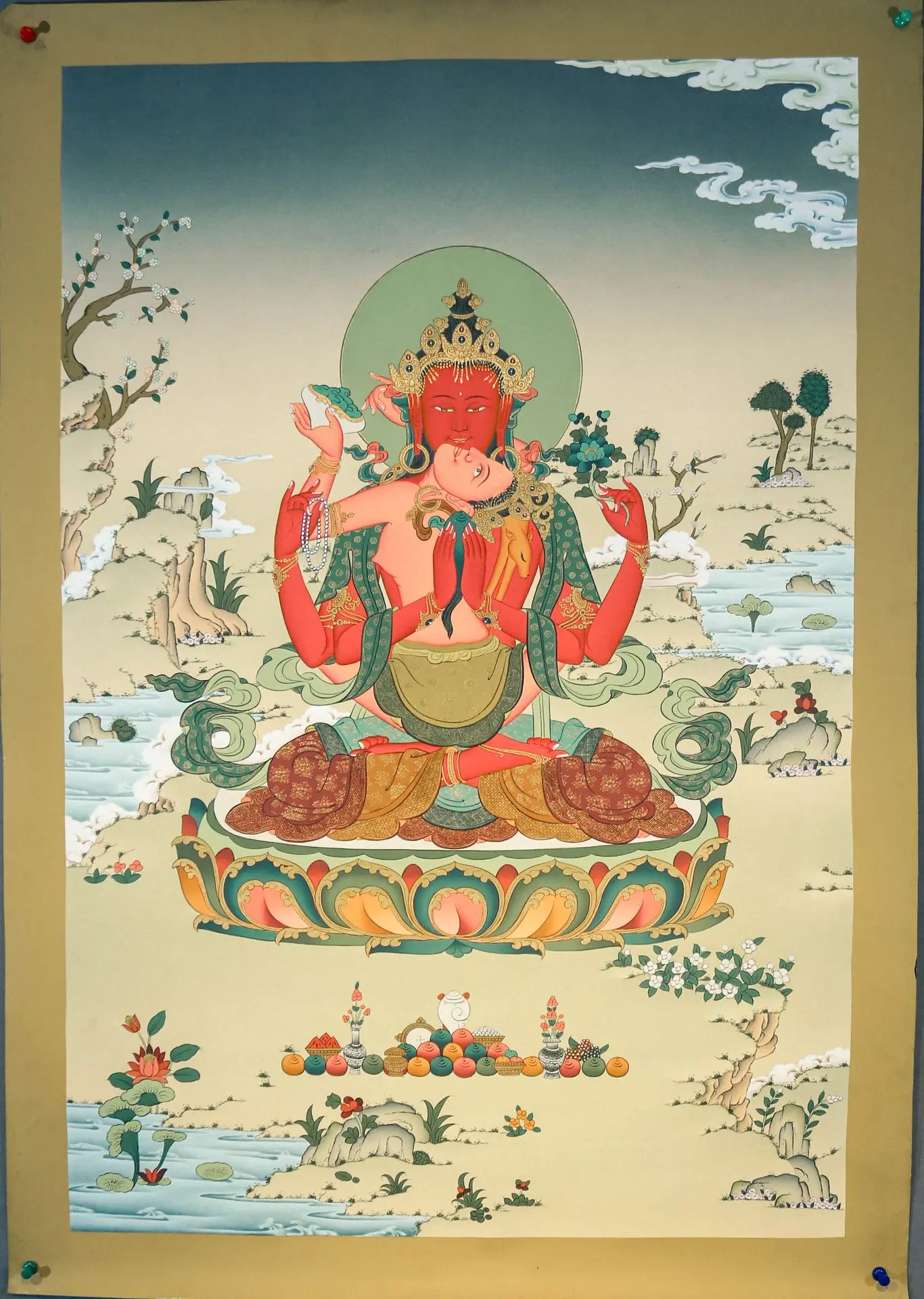
Find this thangka here.
This is the advanced tantric red form.
Gyalwa Gyatso means "Ocean of Victorious Ones." He appears red, in union with his consort — representing wisdom and compassion as fundamentally inseparable.
His Iconography Decoded
- Red body in Yab-Yum — male and female in union
- Not sexual imagery: the ultimate symbol of wisdom inseparable from compassion
- Skull crown and bone ornaments of a tantric deity
The Specialized Forms
Amoghapasha: The Unfailing Lasso
This is the form that catches you before you fall.
Some beings are heading toward terrible rebirths. Increasing confusion. Lives of deepening darkness.
Amoghapasha throws his lasso of compassion and catches them. Pulls them back from the edge. "Amoghapasha" means "unfailing noose." His aim never misses. His rope never breaks.
His Iconography Decoded
- Eight arms — holding the lasso as his primary implement
- The lasso curves gracefully — not a weapon of capture but a lifeline of rescue
- Third eye: Omniscient awareness of exactly who needs catching
Chintamani: The Wish-Fulfilling Jewel Form
This is the form of the deepest wish.
This form emphasizes Chenrezig's power to grant what beings truly need. Not superficial desires. The deepest wish of every heart: freedom from suffering.
His Iconography Decoded
- Prominent wish-fulfilling jewel held at the heart or radiating light
- The jewel is the visual center — it must appear to glow and radiate
- Sometimes six arms representing one syllable of the mantra each
Pretasantarpina: Savior of Hungry Ghosts
This is the form that goes where no one else will.
Of all the realms of suffering, the hungry ghost realm is among the most pitiable. Beings there are consumed by insatiable hunger. They see food and water — but it turns to fire when they try to consume it.
Chenrezig takes this form specifically to enter their realm. He feeds them. He quenches their thirst. He goes where everyone else refuses to go.
His Iconography Decoded
- Offering food and drink as primary activity
- Surrounded by gaunt, desperate figures receiving his gifts
- His compassionate expression shows particular tenderness in this form
Mahakarunika: The Great Compassionate One
This is the title-form of pure compassion.
This name is less a distinct physical form and more a title that can apply to any Chenrezig depiction. "Mahakarunika" means simply "Great Compassion."
It emphasizes the quality itself rather than any specific manifestation. When this title is used, the compassionate gaze becomes the focal point of everything.
Chenrezig's Connection to Tara
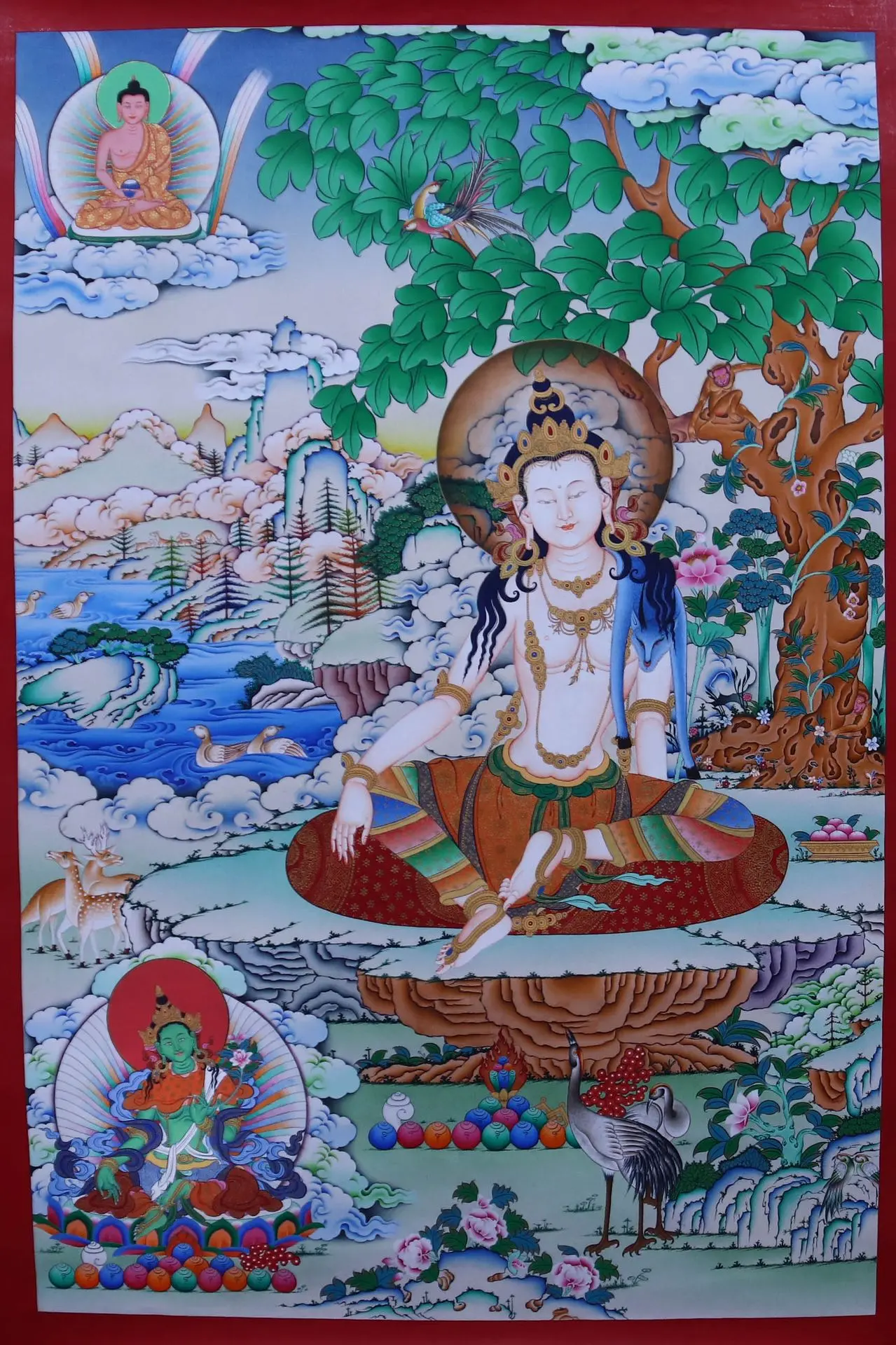
Find this thangka here.
Every form of Tara traces back to Chenrezig. Here is the story.
Chenrezig wept. He wept for the suffering he could not end fast enough. Two tears fell from his eyes.
From the tear of his left eye arose Green Tara — swift, active, leaping into immediate action.
From the tear of his right eye arose White Tara — serene, watchful, granting long life and healing.
Tara looked at him and said: "Do not weep. I will help you. I will work beside you until every being is free."
This is why Green Tara and White Tara always relate back to Chenrezig. They are his sorrow transformed into active help.
- Green Tara: Swift compassionate action — born from his left tear
- White Tara: Patient compassionate presence — born from his right tear
Chenrezig and the Dalai Lama: Compassion in Human Form
This surprises many Westerners. Tibetans do not pray to Chenrezig as a distant cosmic being only.
They believe he walks among them right now. In human form.
The Dalai Lama is Chenrezig.
How This Works
Buddhist teaching describes tulkus — enlightened beings who take physical form to help others. The Dalai Lamas are recognized as Chenrezig's tulkus.
Not symbols. Not representatives. Actual manifestations of living compassion in human bodies.
This recognition began formally with the Third Dalai Lama in the 1500s. The Fifth Dalai Lama cemented it permanently — building the Potala Palace in Lhasa and naming it after Potalaka, Chenrezig's mythical mountain home in the sutras.
- The palace itself became Chenrezig's earthly residence
- Politics and spirituality merged in white stone and gold
What This Means Today
For Tibetans, this connection transforms everything. When they see the Dalai Lama, they see Chenrezig in human form.
His teachings become Chenrezig's voice. His activism becomes Chenrezig's hands at work in the modern world.
The Fourteenth Dalai Lama has brought this compassion globally. Through interfaith dialogue, Nobel Peace Prize work, and universal teaching — Chenrezig's essence reaches far beyond Buddhist circles.
Om Mani Padme Hum: The Mantra That Became a Civilization
You cannot separate Chenrezig from his mantra.
Om Mani Padme Hum.
Six syllables. The spiritual heartbeat of Tibet.
What Each Syllable Actually Does
The common translation — "The Jewel in the Lotus" — barely scratches the surface. Each syllable is a complete practice:
- OM: Purifies pride. Opens the door to generosity.
- MA: Purifies jealousy. Cultivates ethical conduct.
- NI: Purifies attachment. Develops patience.
- PAD: Purifies ignorance. Builds perseverance.
- ME: Purifies greed. Strengthens concentration.
- HUM: Purifies hatred. Awakens wisdom.
Six poisons transformed into six wisdoms. One syllable at a time. The entire Buddhist path in six sounds.
The Mantra Carved Into the Earth
Travel through Tibet or Nepal. Om Mani Padme Hum is everywhere.
Carved into stones stacked into walls stretching for miles. Painted on cliff faces. Spinning on prayer wheels powered by mountain streams.
Tibetans believe the mantra benefits all beings who encounter it. Even an insect walking across a mani stone receives blessing. Chenrezig's compassion made physical. Permanent. Woven into the landscape itself.
How Chenrezig Evolved Through History
Indian Origins: 2nd to 7th Century
Avalokiteshvara first appears in Indian Mahayana texts.
The Lotus Sutra describes him as a bodhisattva who takes any form to help suffering beings. The Karandavyuha Sutra elevates him further — establishing Om Mani Padme Hum and positioning him as a cosmic savior.
In early Indian art, he appears simply. Two arms. One lotus. Standing gracefully. This is the Padmapani form — visible in the caves of Ajanta, carved at Ellora.
The Tantric Expansion: 7th to 12th Century
As Vajrayana Buddhism developed in India, Avalokiteshvara multiplied.
Tantric texts generated dozens of new forms. Multi-armed. Multi-headed. Wrathful. Each form designed for a specific practice.
- Hayagriva emerged as his wrathful emanation
- Amoghapasha gained eight arms and an unfailing lasso
- The thousand-armed form crystallized into its iconic image
Arrival in Tibet: 7th to 8th Century
When Buddhism entered Tibet, Chenrezig came with it.
The Tibetan origin myth claims that Chenrezig looked upon the snowy land and saw beings trapped in darkness. He emanated as a monkey. He became the ancestor of the Tibetan people.
Tibet did not just adopt Chenrezig. Tibet claimed to be descended from him. He became the father of the nation.
King Songtsen Gampo in the 7th century was recognized as Chenrezig's emanation. He built the Jokhang Temple in Lhasa. Chenrezig's influence became inseparable from Tibetan identity.
The Dalai Lama Institution: 15th Century Onward
The recognition of Dalai Lamas as Chenrezig's emanations transformed him from a cosmic being into a living political and spiritual reality.
The Fifth Dalai Lama's construction of the Potala Palace made Chenrezig's presence architectural. Monumental. Unavoidable.
Chenrezig in Exile: 1959 to Present
After the Chinese invasion, the Fourteenth Dalai Lama carried Chenrezig's presence into exile.
Through global teaching tours and interfaith dialogue, Chenrezig's compassion reached audiences far beyond Buddhist circles. Om Mani Padme Hum now echoes in New York yoga studios, London meditation centers, and São Paulo Buddhist communities.
Chenrezig has gone global.
Why Chenrezig Matters Right Now
We live in a distracted, often indifferent world. Compassion is discussed endlessly but practiced rarely.
Chenrezig offers something practical. A daily reminder. A story that embodies what we aspire to become.
His life says:
- Compassion can be practiced. It is not a feeling — it is a skill that develops
- No one is beyond care. His vow includes every being — even the ones you find difficult
- Patience endures. His commitment spans infinite time — yours can span today
- Despair is not the end. He shattered. He came back stronger. So can you.
Frequently Asked Questions
Is Chenrezig male or female? In Tibet he appears male or beyond gender entirely. In China the same being manifests as female Guanyin. Compassion transcends such categories.
Do I need to be Buddhist to connect with Chenrezig?
No. His peaceful presence and his story speak to universal human concerns. Anyone can benefit from his teachings on compassion.
Should I receive an empowerment to practice with Chenrezig?
Basic devotion — reciting the mantra, contemplating his story — requires no formal empowerment. Advanced visualization practices benefit from proper transmission.
What is the difference between Chenrezig and Tara?
Tara arose from Chenrezig's tears. She represents swift action. He represents compassion's essence. Intimately related but distinct beings.
How do I pronounce Chenrezig?
Approximately "Chen-ray-zig." Emphasis on the first syllable. The z is soft.
Why does Chenrezig have so many forms?
Different beings need different approaches. His many forms represent compassion's infinite adaptability — meeting each being exactly where they are.
The Gaze That Never Wavers
Chenrezig has watched over beings for millennia.
Through empires rising and falling. Through wars and plagues and moments of unexpected grace.
His eyes never close. His hands never drop. His commitment never flickers.
He is the one who looked at a universe drowning in suffering and said: "I will stay."
And he meant it.
His story reminds you — daily, silently, beautifully — that compassion is real. That you are seen. That the one who hears every cry has heard yours too.
May all beings benefit.
Om Mani Padme Hum.