You browse a gallery of Tibetan art. You see a golden Buddha. Peaceful. Serene.
You see a Green Tara. Beautiful. Welcoming. Then you turn the page.
And you see a monster.
He has three bulging eyes. A ring of fire surrounds him. He wears a necklace of severed heads.
He bears sharp fangs. He stands on a corpse. Your first instinct? Run.
Or scroll past quickly. It’s a natural reaction. To Western eyes, these look like demons.
They look like nightmares. They look like bad guys. But here is the twist.
In Tibetan Buddhism, these are the good guys. They might be the most compassionate figures of all.
If these images scare or confuse you, read on. We’re going to decode the fear together.
We’ll explain why peace-loving Buddhists paint them. You might just discover you need a “scary” Thangka.
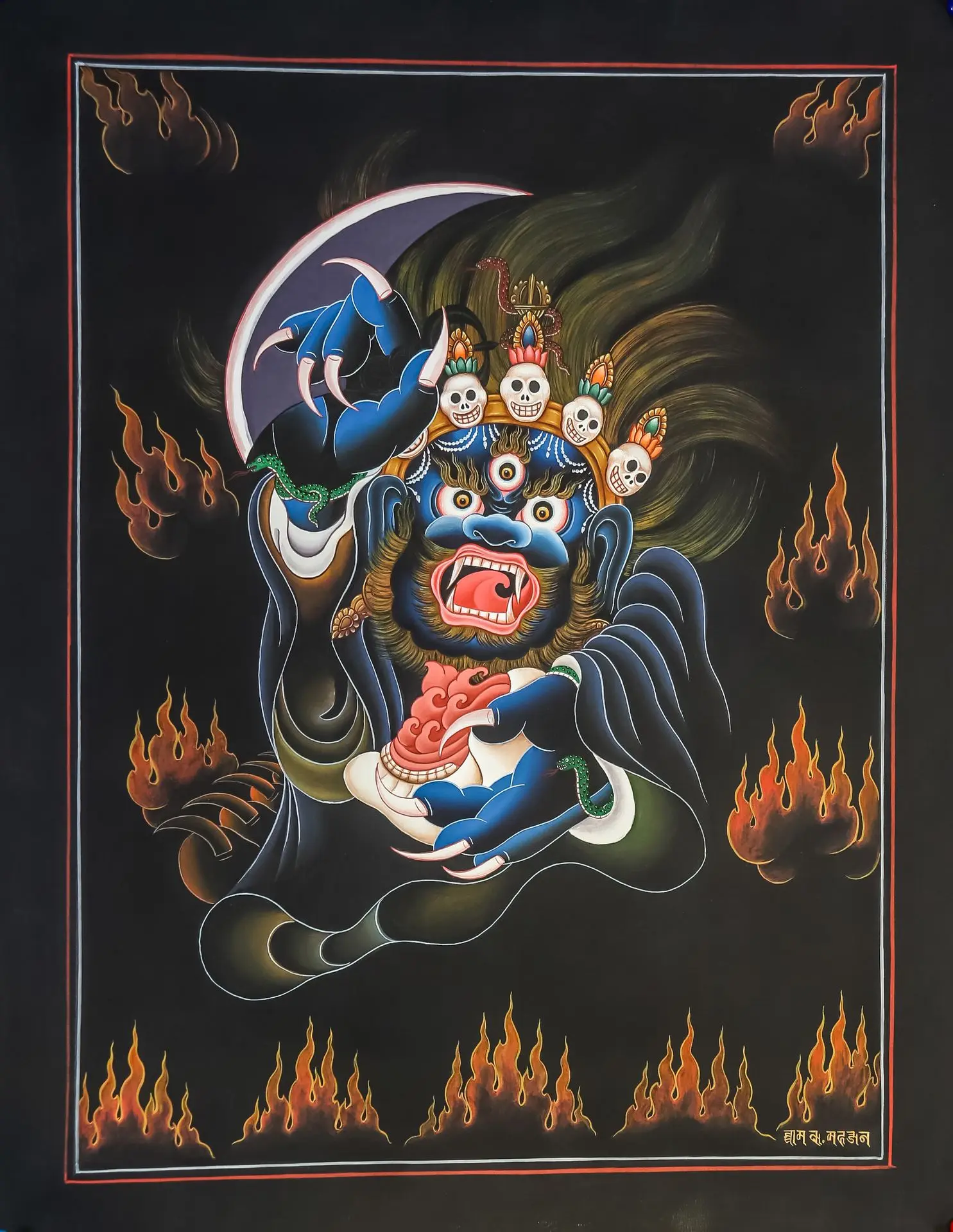
Find this thangka here.
The Concept of Fierce Compassion
Let’s start with a simple question. Is compassion always soft and gentle?
Picture a mother walking with her child, a dog attacks. A stranger grabs the kid. What does the mother do? She doesn’t smile softly or speak calmly.
She screams. She fights. She becomes terrifying. To the attacker, she appears to be a demon. Is she angry? No. She protects what she loves. Her wrath is fierce love.
This is the secret of the wrathful deities. They are called Dharmapalas in Sanskrit. That means “Protectors of the Truth.” They are bodyguards of the spiritual world.
They are not fighting you. They are fighting for you.
They fight the obstacles that block your happiness. They face the inner demons that trouble their minds.
Decoding the Nightmare: What the Symbols Mean
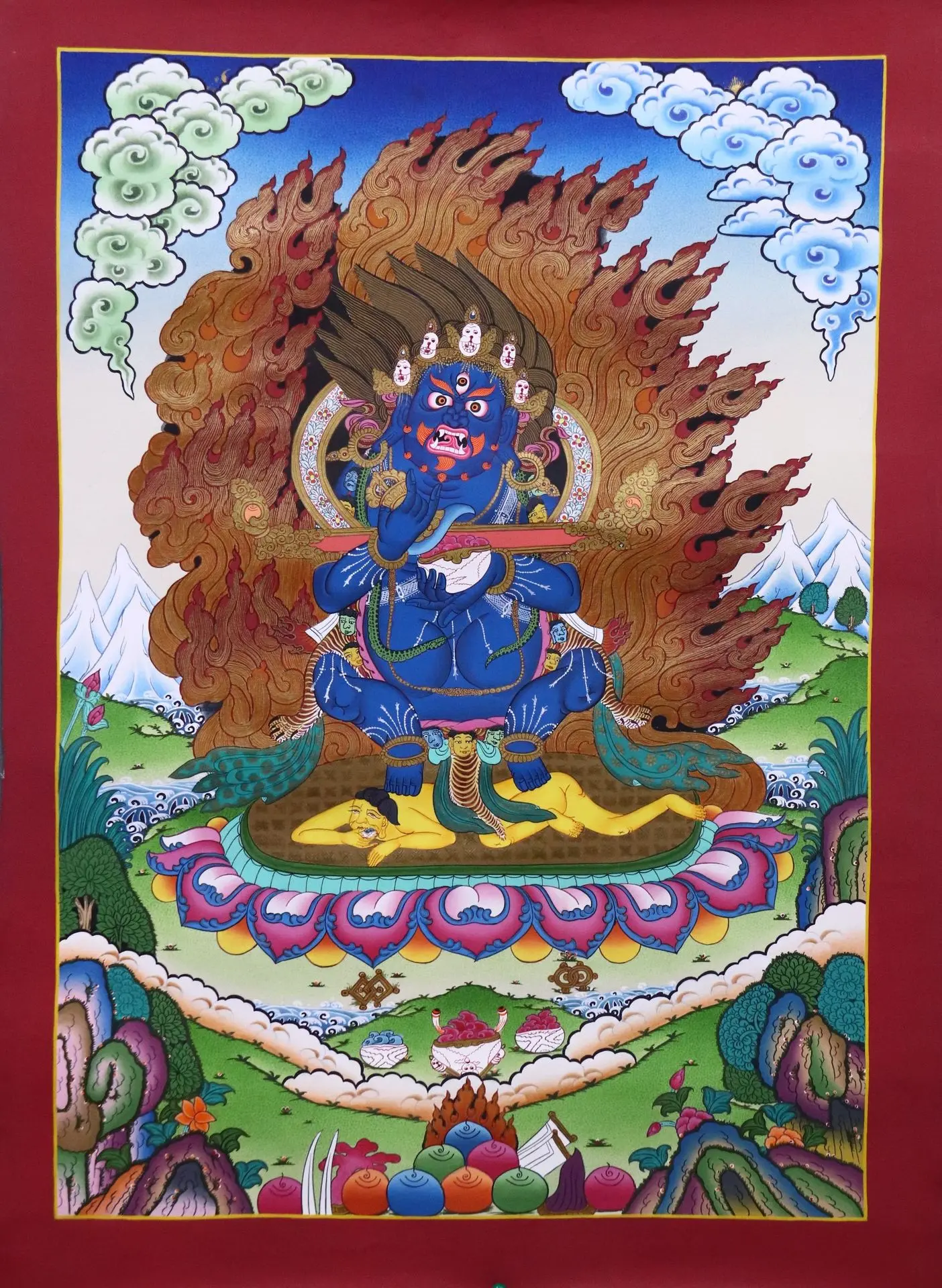
Find this thangka here.
The scary imagery is not random. It’s a precise spiritual language.
Once you learn the code, the fear dissolves. The horror turns into a map of wisdom.
The Ring of Fire
You see a wall of flames surrounding the deity. This is not hellfire.
It is the fire of wisdom. Wisdom burns.
It burns away ignorance and ego. It burns the thoughts that keep you awake.
The deity lives inside that fire naturally. They are made of pure, blazing awareness.
The Three Eyes
Many wrathful deities have three eyes. The third eye sits in the forehead.
It represents omniscient awareness. They see past, present, and future at once.
Nothing is hidden from them. No suffering goes unnoticed.
The Fangs and Bared Teeth
The snarl looks terrifying. But who are they threatening?
They threaten the demons of your mind.
- Laziness. The teeth snap it awake.
- Self-doubt. The growl silences it.
- Arrogance, greed, and attachment. The roar banishes them.
The anger is aimed at what hurts you.
The Weapons: Swords, Hooks, and Choppers
They carry fierce implements. Each weapon has a kind purpose.
- The sword cuts through confusion.
- The hook pulls you back from bad choices.
- The chopper severs attachment and clinging.
- The vajra (thunderbolt) shatters the hardest obstacles.
These are tools of liberation, not violence.
The Skulls and Severed Heads
This is the hardest part for many. Why the gore?
In Buddhism, skulls mean the death of the ego. The severed head represents conquered selfishness.
The deity wears them as trophies of freedom. “I have defeated the small self,” they say.
No real person was ever harmed. It’s a metaphor for inner victory.
Trampling on Figures
You often see the deity standing on a body. They are not crushing an innocent person.
They are crushing a metaphor.
- The “ego-demon” lies pinned beneath their feet.
- The forces of ignorance cannot rise to hurt you.
The weight of enlightened power holds them down.
Meet the Wrathful Deities
Many fierce beings guard the teachings. Each has a unique role and energy.
Here are the ones you’ll encounter most.
Yidams: Wrathful Meditational Deities
Yidams are deities you become in meditation. You visualise yourself as them completely.
They transform your ordinary body and mind. Here are the most powerful ones.
Chakrasamvara: Wheel of Supreme Bliss
Chakrasamvara is a deep blue Yidam. He has multiple faces and arms.
His most famous form is twelve-armed. He embraces his consort Vajravarahi.
- Two-armed and four-armed versions also exist.
- Luipa, Ghantapada, and Krishnacharya lineages shape his forms.
- The Sixty-Two Deity Mandala is his complete realm.
He dances on figures of ego and delusion. His practice transforms desire into blissful wisdom.
He brings swift realisation to serious practitioners. Many Kagyu masters made him their heart practice.
Hayagriva: The Horse-Headed One
Hayagriva is a ferocious red deity. A green horse head emerges from his hair.
The horse head neighs and shakes the realms. He is a wrathful form of Avalokiteshvara.
- Two-armed, four-armed, six-armed, and eight-armed forms exist.
- He appears with Vajravarahi in union.
- The Three Fierce Ones combine him with Vajrapani and Garuda.
- Secret Hayagriva is a profound Nyingma transmission.
He protects the spoken teachings of Buddha. He clears negative karma from harmful speech.
Hevajra: The Joyful Vajra
Hevajra is the central Yidam of the Sakya school. He is dark blue, dancing on fear itself.
- His sixteen-armed form has eight faces.
- He embraces his consort Nairatmya in bliss.
- Two-armed and four-armed forms simplify his practice.
- The Nine-Deity Mandala is his sacred home.
He transforms hatred and aversion into wisdom. His sixteen arms hold offerings of complete transformation.
Yamantaka: Conqueror of Death
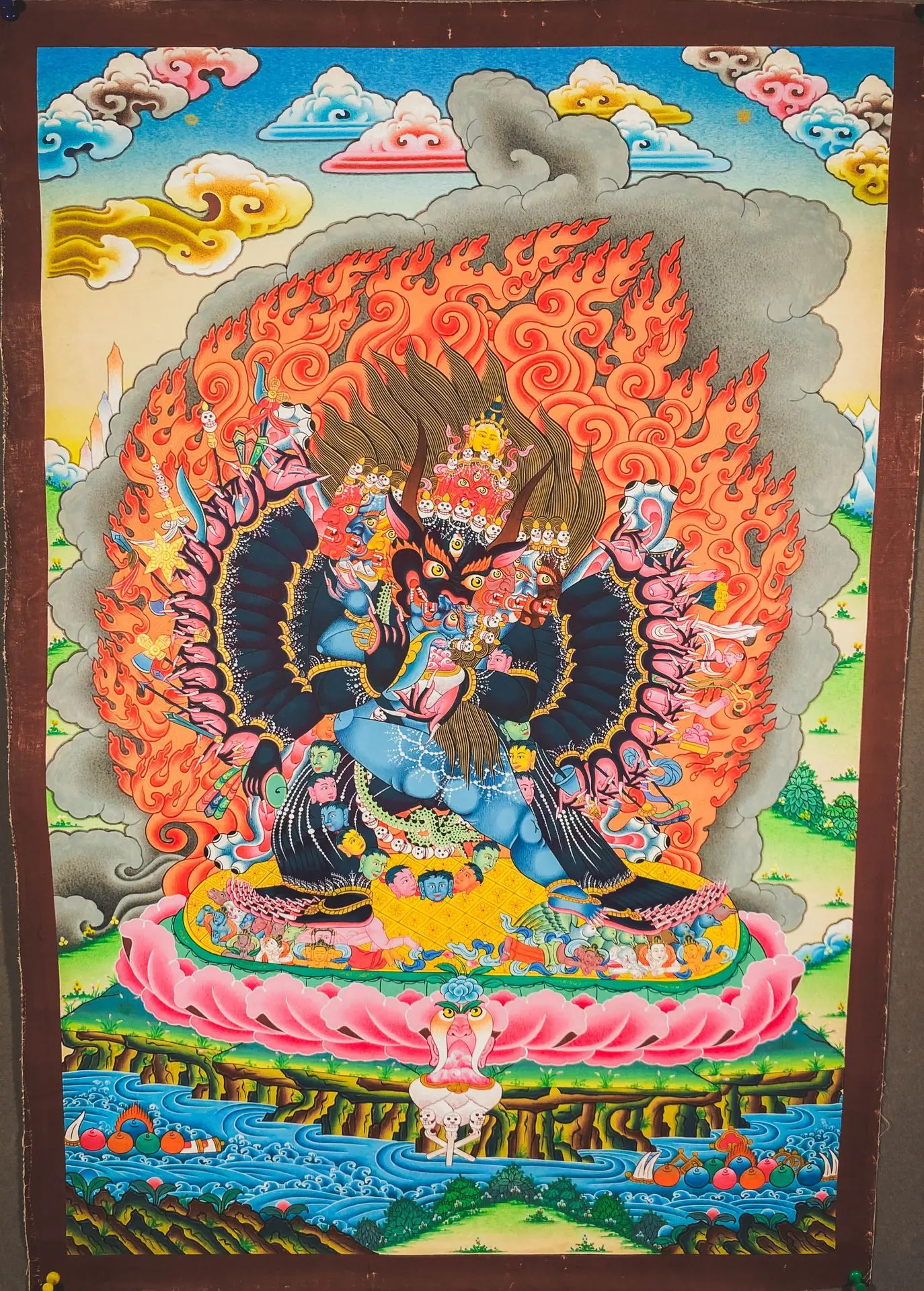
Find this thangka here.
Yamantaka is the wrathful form of Manjushri. Manjushri is the gentle Bodhisattva of Wisdom.
To defeat Death itself, wisdom became terrifying. Yamantaka means “Ender of Yama, Lord of Death.”
- His single form has nine faces and thirty-four arms.
- Sixteen legs stomp forces of ignorance flat.
- The buffalo head is his most striking feature.
- Manjushri’s peaceful face crowns his head.
- Thirteen-Deity and Forty-Nine-Deity mandalas amplify his power.
He removes the ultimate obstacle: fear of death. He dismantles our misunderstanding of impermanence.
Vajrakilaya: The Dagger Deity
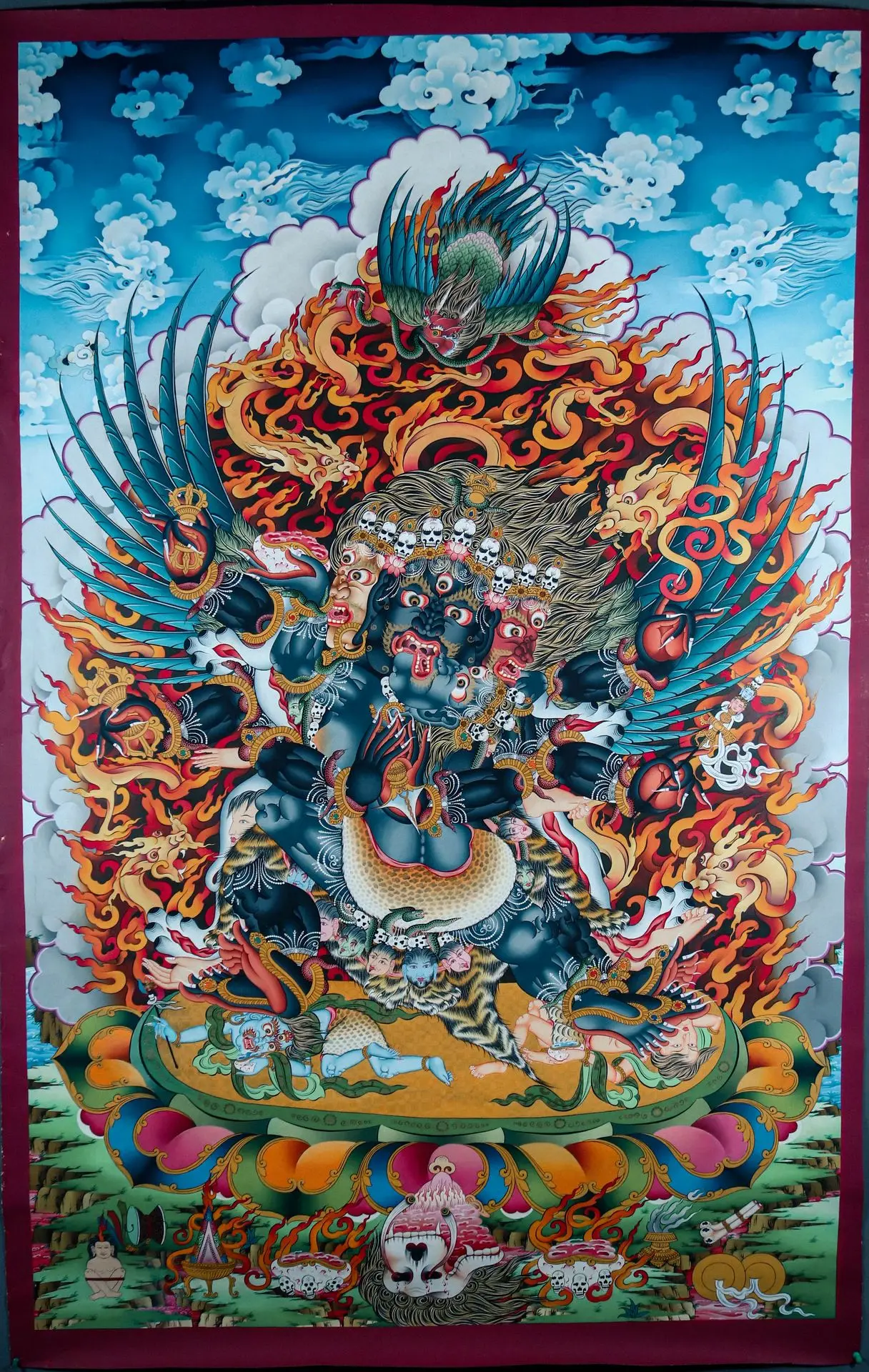
Find this thangka here.
Vajrakilaya is the deity of the ritual dagger. His lower body becomes the three-sided phurba.
He doesn’t just hold the dagger—he is it. He drills obstacles into the earth forever.
- His six-armed form is most common.
- He has three faces: blue, white, and red.
- He appears with consort Diptachakra in union.
- Flying Vajrakilaya clears obstacles before they land.
Padmasambhava used this practice to subdue Tibet. It’s often the first and last resort for blockages.
Vajrayogini and Vajravarahi: The Supreme Dakinis
Vajrayogini is the highest female Yidam. She flies through space, red and alive.
- Naropa Vajrayogini stands in a tilted dancer’s pose.
- Vajravarahi has a sow’s head behind her ear.
- Chinnamasta Vajrayogini appears self-decapitated—ego severed.
- Dechen Gyalmo is the Sakya Queen of Bliss.
- Krodha Kali is pure wrathful ferocity.
She turns desire into the fuel for awakening. Her path can lead to enlightenment in one life.
Simhamukhi: The Lion-Faced Dakini
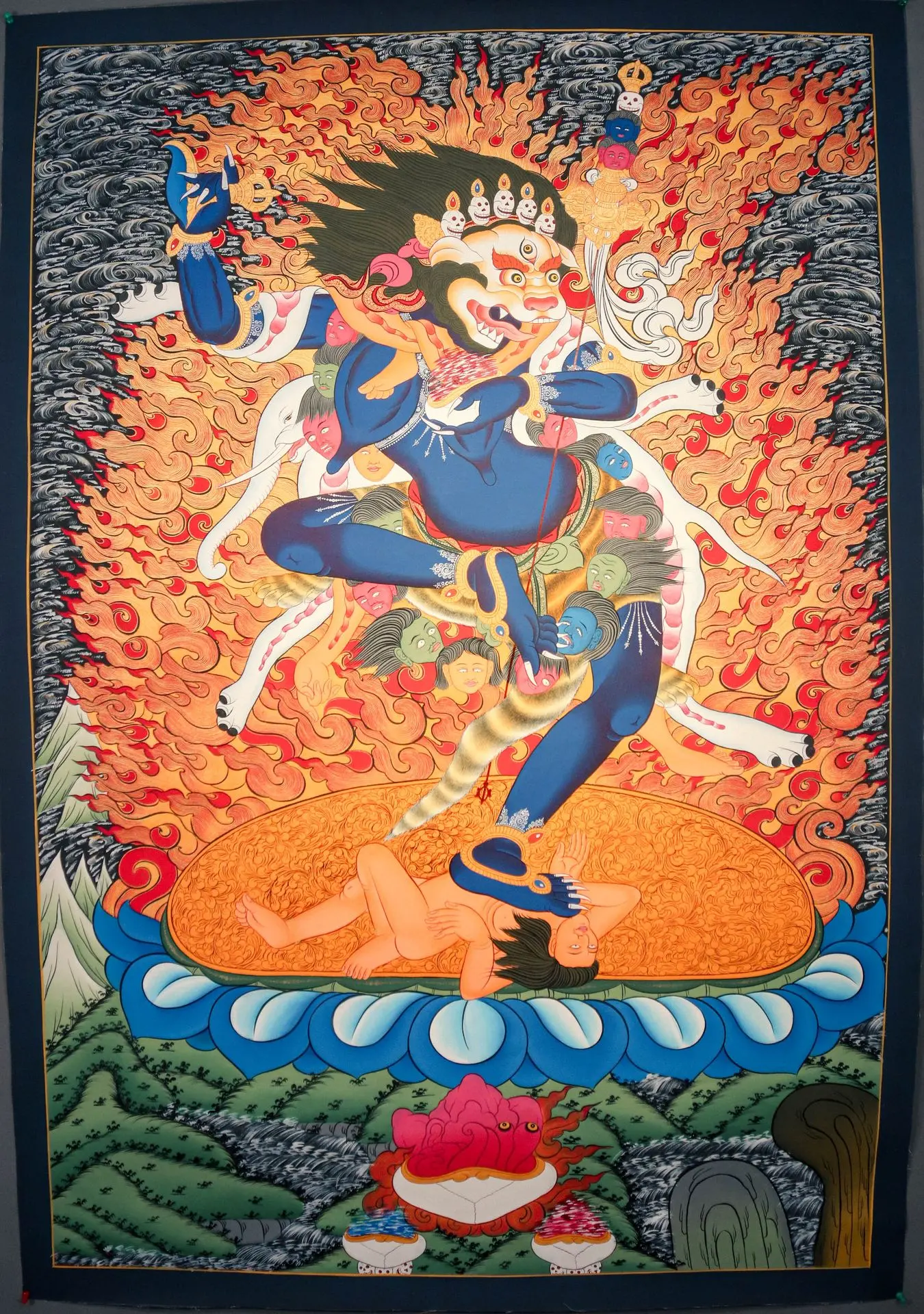
Find this thangka here.
Simhamukhi has the head of a lion. Her body is that of a wrathful woman.
- Blue, red, and white forms exist.
- Four-armed versions hold a chopper and a skull cup.
- She roars, and illusion shatters.
She reverses black magic and harmful intentions. She clears curses and psychic attacks instantly.
Troma Nagmo: The Black Wrathful Mother
Troma Nagmo is a fearsome dark goddess. She dances on a corpse with Chöd implements.
- Her single form holds a damaru, a bell, and a khatvanga.
- Her retinue assembles wrathful dakinis around her.
- She is an emanation of Machig Labdron.
She cuts the root of ego-clinging directly. Chöd practitioners offer their own bodies fearlessly.
She heals a disease born from deep self-grasping. She meets fear in charnel grounds and destroys it.
Nairatmya: She Who Has No Self
Nairatmya means “absence of a fixed self.” She is the consort of Hevajra.
- She stands alone, dark blue, with a knife and skull cup.
- She appears in union with Hevajra.
- Her mandala includes fifteen attendant goddesses.
She embodies the direct experience of emptiness. To meditate on her is to dissolve the ego.
Dharmapalas: The Wrathful Protectors
Dharmapalas guard the teachings and the practitioner. They are not meditational deities you become.
They stand beside you as fierce allies. Here are the most important ones.
Mahakala: The Great Black One
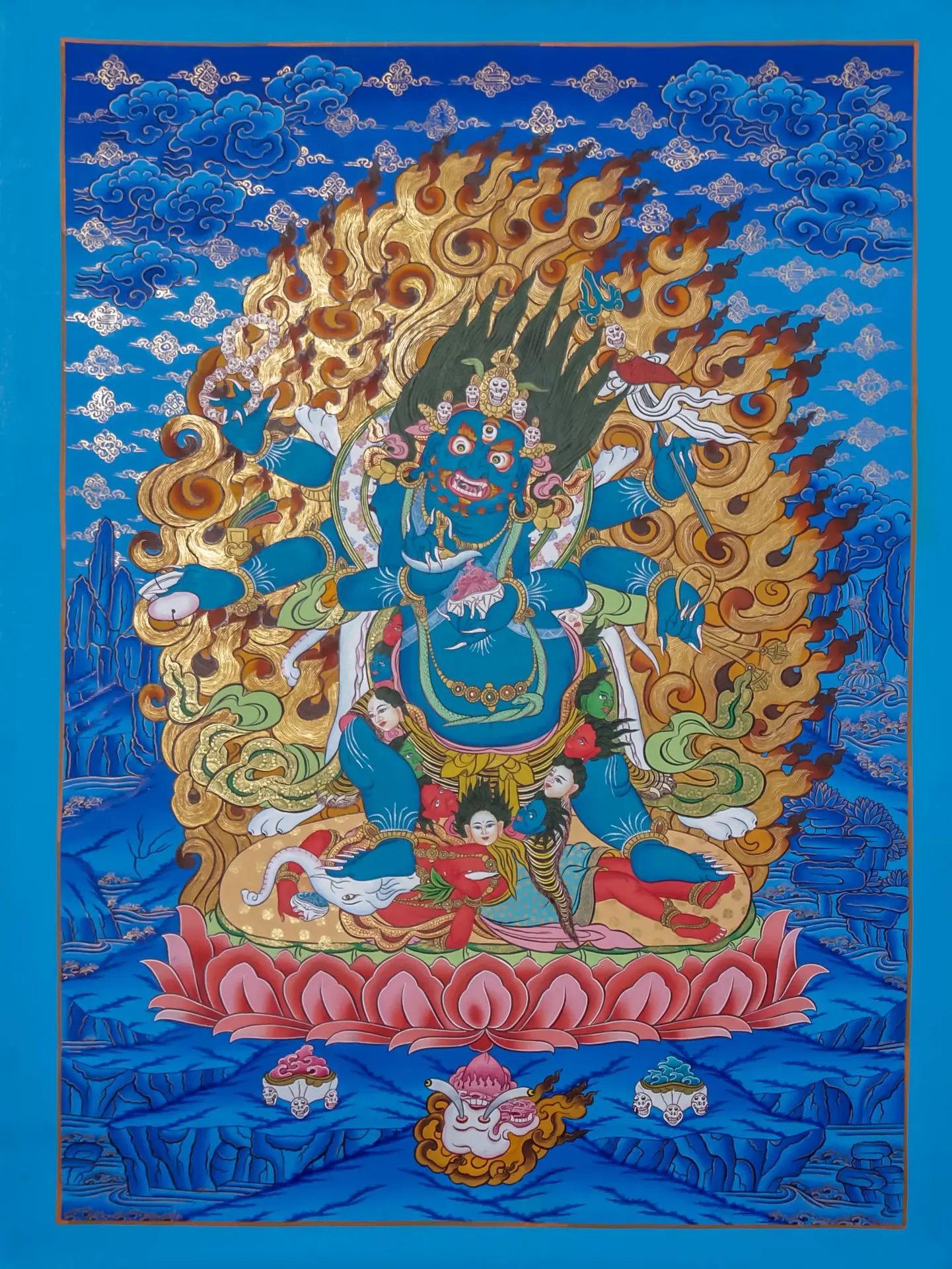
Find this thangka here.
Mahakala is the supreme protector. He is dark blue or black, fierce and strong.
Here is the secret: Mahakala is Avalokiteshvara. The Buddha of Compassion took this form.
When gentle methods are not enough, compassion fights. It becomes Mahakala.
- Two-Armed Mahakala is his basic form.
- Four-Armed Mahakala intensifies protection.
- Six-Armed Mahakala guards the Dalai Lamas.
- Bernakchen protects the Karma Kagyu lineage.
- Panjara Mahakala guards the Hevajra Tantra.
- White Mahakala brings wealth and removes poverty.
- Gurgon protects the practitioner’s environment.
He clears all obstacles with ruthless kindness. Monasteries invoke him every single morning.
Vajrapani: Holder of the Thunderbolt
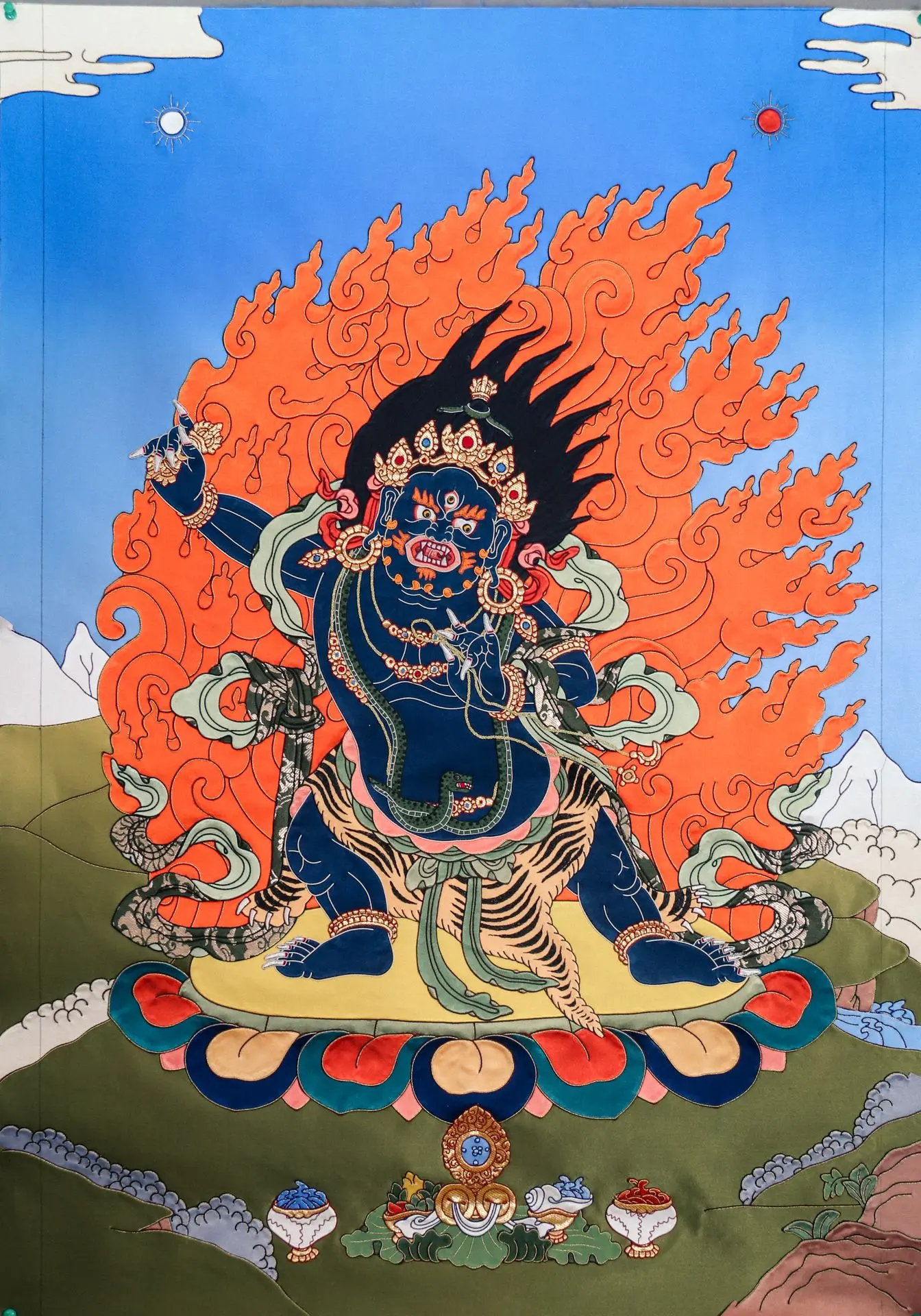
Find this thangka here.
Vajrapani embodies the power of all Buddhas. He is one of the Three Protectors.
- Peaceful Vajrapani holds a vajra, serene but strong.
- Wrathful Vajrapani (Chanda) is blue and flaming.
- Mahachakra Vajrapani has multiple arms for vast action.
- Bhutadamara Vajrapani subdues spirits and demons.
- The Three Fierce Ones join him with Hayagriva and Garuda.
He gives you strength when you feel weak. He is spiritual rocket fuel for hard times.
Yamadharmaraja: Lord of Death as Protector
Yama is the buffalo-headed Lord of Death. But here, he is a protector of justice.
- Outer, Inner, and Secret forms deepen the practice.
- He holds the Mirror of Karma.
- Kalarupa and Mandala forms expand his court.
He ensures no action escapes its consequence. He protects truth and guides the dying.
Palden Lhamo: The Glorious Goddess
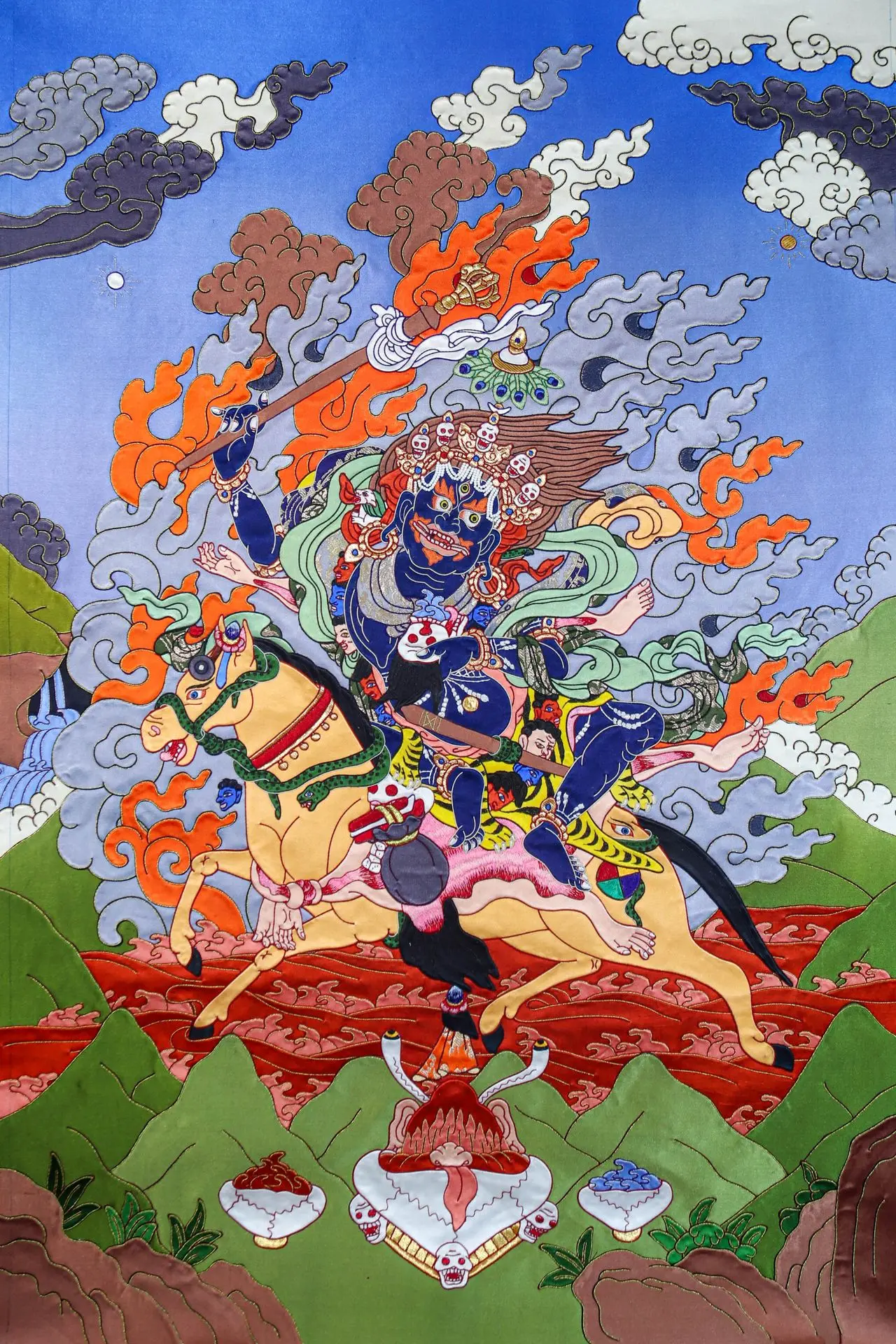
Find this thangka here.
Palden Lhamo is the only female Dharmapala. She rides a mule across a sea of blood.
- Magzor Gyalmo protects the Dalai Lama.
- Dusolma is a smoky, ancient form.
- Remati is a sky-going wisdom goddess.
She guards the Land of Snows and the teachings. She made a fierce vow to protect, no matter what.
Begtse Chen: The Great Coat of Mail
Begtse Chen is a red warrior in armour. He holds a sword and a dripping heart.
- He stands with his sister Rigpai Lhamo.
- The Eight Butchers form his retinue.
- He was an enemy who became a protector.
He converts hostility into fierce protection. His story is one of hope and transformation.
Ekajati: The One-Braid Goddess
Ekajati has one eye, one fang, and one braid. She is deeply ferocious and utterly loyal.
- Two-armed, four-armed, and twelve-armed forms exist.
- The wolf accompanies her.
- She is the primary Nyingma guardian of Dzogchen.
She protects the most secret teachings from misuse. She has power over nagas and spirit realms.
Rahula: The Eclipser
Rahula is a complex, many-eyed protector. Nine heads are crowned by a raven.
- His body is covered with eyes.
- The lower half is a coiled serpent.
- He holds a bow and arrow for astrological obstacles.
He governs eclipses and unfavourable planetary forces. He punishes broken vows and protects samaya.
Citipati: Lords of the Charnel Ground
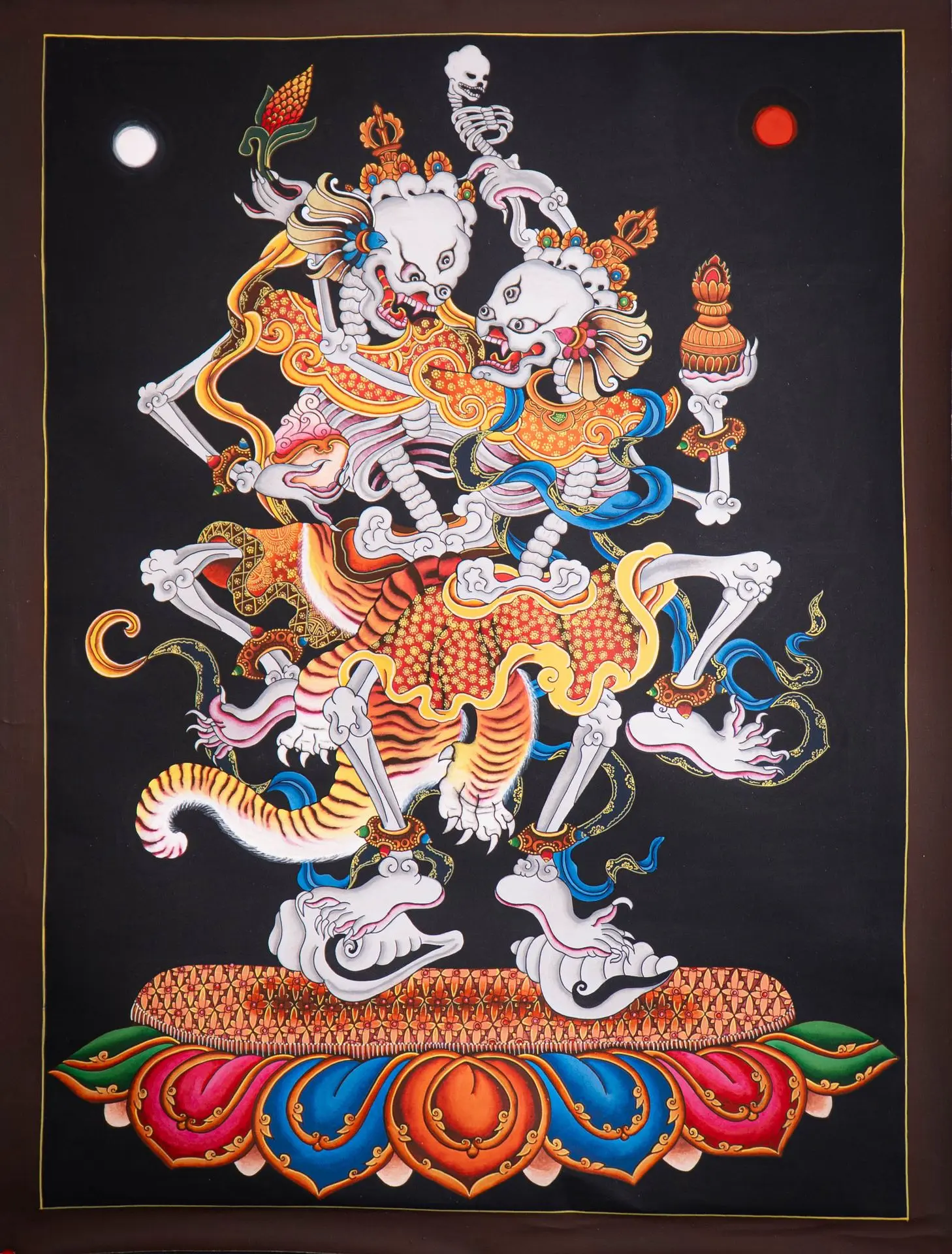
Find this thangka here.
Citipati are dancing skeleton protectors. They appear as a joyful, eternal couple.
- Their dance celebrates impermanence.
- They guard sky-burial sites.
- You see them in Cham masked dances.
They protect the dead and the dying. They remind us that death is a teacher.
Why Would You Put This in Your House?
You might understand the symbolism now. But do you really want one at home?
Many people say yes without hesitation. Here’s why.
For Protection
You lock your door at night. A Dharmapala is a spiritual security system.
It’s not superstition—it’s intention. Negative energy is not welcome here.
For Psychological Strength
Life asks you to be tough sometimes. Gentle images may not give you that fire.
A fearless figure can ignite your courage. It helps you face illness, injustice, or struggle.
For Cutting Through Mental Fog
These images are impossible to ignore. They snap the mind to attention instantly.
For some temperaments, this is what works. A peaceful Buddha might not shake you awake.
For Serious Practitioners
Vajrayana practitioners need their protector nearby. The Thangka is a functional meditation tool.
It supports visualisation, offering, and daily connection. It is not decoration—it is practice.
Where Do Wrathful Thangkas Belong?
Placement matters because the energy is strong. Here is what tradition and experience suggest.
- Near the main entrance. They face the door.
- In the office or workspace for power.
- On a private altar, perhaps behind a curtain.
- Not the bedroom. The energy is too activating.
They stand guard where protection is needed most.
The Deeper Teaching
Every wrathful deity shares one core truth. Under the fire, beyond the skulls, is love. Love that refuses to give up. Compassion that will not be defeated.
The friend who tells you the hard truth. The ally who pulls you back from the edge. Real protection is not always pretty. The strongest ally may wear a terrifying face.
Conclusion: Look Closer
Tibetan art challenges our comfortable assumptions. “Pretty equals good” is not always true.
Wrathful deities are the ultimate spiritual allies. They do the hard work of protection fearlessly.
They are not demons. They are the fiercest form of love.
Next time you see fangs, fire, and fury, pause. Stand your ground and look closer.
Recognise the protector looking back at you. That fierce energy might be exactly what you need.
Do you feel called to invite fierce protection into your life?
Explore our hand-painted Dharmapala Thangkas and find the ally that resonates with your path.